Why do women choose the dresses they do? And what psychological forces are at play as they sift through silk, lace, and tulle? We dig into this complex situationship.
For many women, the path to her wedding day begins long before the venue is booked or the flowers are chosen – it begins with the dress. A wedding dress is an emotional artifact, a subconscious mirror, and a cultural symbol all wrapped into one. Choosing it is rarely a straightforward decision. It unfolds in layers of identity, tradition, social expectation, and personal aspiration.
Recently, voices within fashion media have highlighted a seismic shift: brides are increasingly rejecting one-size-fits-all options in favor of styles that reflect their individuality. From unconventional silhouettes to bespoke pieces created with a designer, the wedding dress is now an expression of self as much as ceremony.
At the heart of the wedding dress choice lies a psychological phenomenon known as enclothed cognition – the idea that clothing shapes not only how others see us, but how we see ourselves. Social psychologists suggest that the clothes we wear can influence our emotions, confidence, and even cognitive processes. Simply being in the garment imbues the wearer with the symbolic meaning they associate with it.
When a bride slips into a gown and sees a version of herself she resonates with – poised, radiant, powerful, serene – that emotional reaction becomes an anchor. This “emotional anchoring,” where our minds latch onto feelings associated with an object, plays a significant role in decision-making. When a dress triggers memories, self-love, or a long-held vision of the bride one wants to be, that emotional resonance often outweighs cost, trend, or practicality. It’s less about a piece of fabric and more about the “felt self” that emerges when it’s worn.
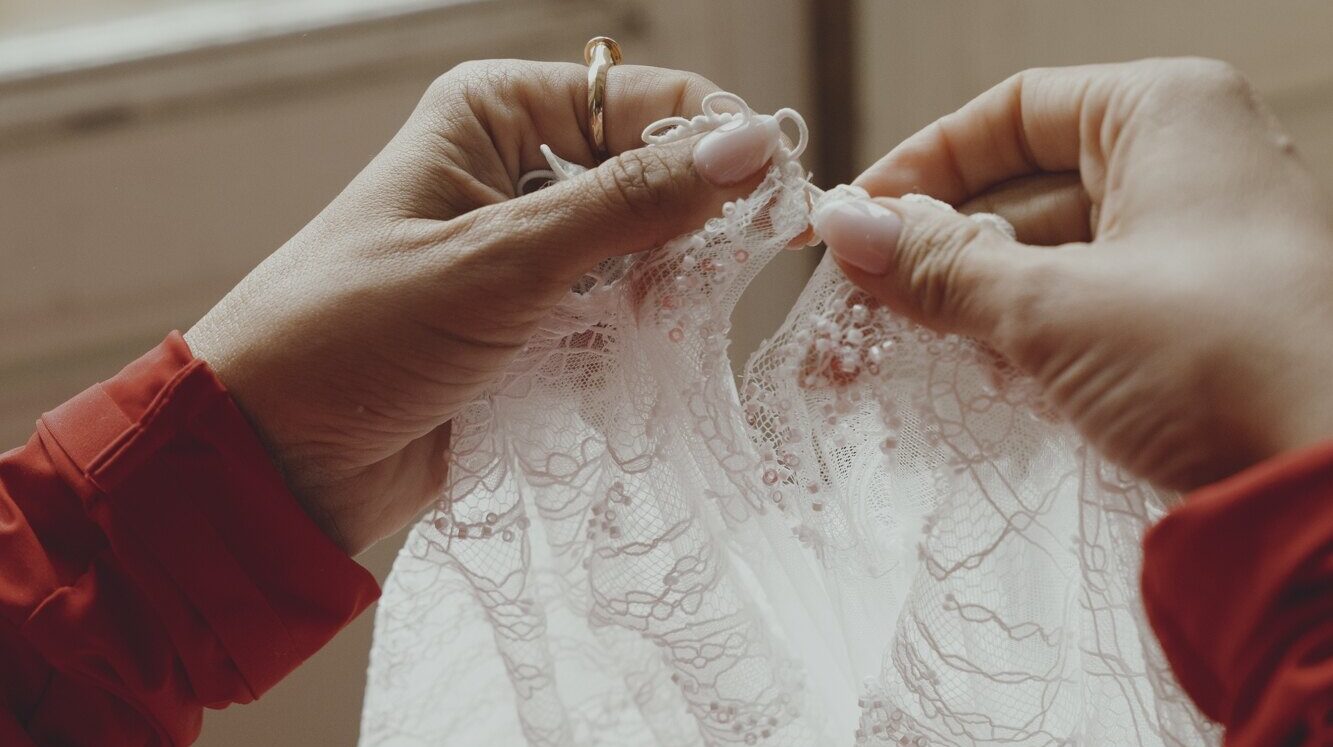
Designing the gown itself mirrors this emotional process. Our Creative Director, Lee Petra Grebenau, explains that creation is guided by instinct as much as technique: “Designing a couture wedding gown feels very much like giving birth. I never truly know that I am finished until I see the gown completed. Only then can I feel whether something is missing or whether it is truly whole. It’s an emotional instinct – when the dress feels complete, harmonious, and alive, I know it is finished.”
Another layer of the bridal dress situationship is something called silhouette identity theory: the idea that the shape and structure of a dress reflect deeper aspects of self-image. Fashion editors are now noting how brides are increasingly opting for haute couture pieces that defy bridal tradition altogether. It is de rigueur for brides to collaborate with designers, choose bespoke dresses, or select multiple ensembles to represent different facets of themselves throughout their celebration. The silhouette becomes a way for brides to communicate how they want to feel: regal, playful, empowered, authentic.
For designers who specialize in custom couture, this collaboration becomes an intimate act of co-creation. Grebenau describes the creative spark that emerges when a bride’s individuality takes center stage: “I deeply love creating custom designs – sitting one-on-one with a bride, sketching, imagining, and building something entirely from scratch just for her,” she recounts.
“Not long ago, a bride came to me after visiting many bridal houses. She was searching for a gown in soft shades of pink, with highly detailed custom embroidery. She came to me quite early in her search. We sat together, and I felt genuinely creatively ignited. Designing her fabric, shaping her silhouette, hand-dyeing layers of tulle in delicate gradients…I truly let myself go. It became a breathtaking couture piece. Two weeks later she returned and said: ‘Lee, I visited so many designers, and no one wanted to truly design for me. They all offered what already existed. You were the only one who was excited to create something from scratch just for me.’ Hearing that deeply moved me. That is why I design.”
Of course, intuition plays a huge part in the dress decision-making process. That gut feeling is undeniable, but can also be clouded by several factors. Some stylists and brides speak about the moment when a dress feels just right – a kind of flash of recognition that overrides all the external noise. In many ateliers, that recognition is visible not in words but in posture, expression, and presence – the subtle transformation from trying on a gown to embodying it. Clothing, and especially a wedding dress, serves as a form of non-verbal communication. Grebenau says the process is far more emotional than we even know. “Choosing a wedding dress is an incredibly sensitive process. I observe her body language, the way she moves in the gown, the subtle shifts in her posture. There is a very specific feeling when she has found the one, and it radiates outward,” she explains. “What stands out the most is when she simply cannot stop smiling. There is almost a glow around her – a soft aura of happiness. At that moment, I know. The dress has chosen her.”
Every element of the dress – fabric, color, silhouette – carries meaning about the wearer’s identity, values, and cultural narrative. The whole process can be a source of creative inspiration and empowerment, revealing how clothing and self-image are deeply intertwined. Some brides choose gowns that nod to heritage or tradition; others intentionally break with convention as a form of personal storytelling. These choices are often deeply rooted in cultural identity, family history, or personal values that precede and outlast the wedding day itself.
Psychological research asserts that emotional connection is the core driver of our fashion choices: consumers don’t simply buy a dress for its cut or style – they buy what makes them feel something and the story it tells about who they are or who they aspire to be. Wedding dresses, perhaps more than any other category of apparel, exemplify this. They are laden with symbolism: purity, celebration, union, and often personal or cultural heritage. Emotional products meet deep-seated needs – to feel beautiful, to feel seen, to feel like the best version of ourselves at a pivotal moment.
Choosing a wedding dress has become a ritual where all these perceptions intersect. It’s about seeing a vision of yourself and feeling it resonate in your mind, body, and heart. Whether through intuition or careful deliberation, through tradition or self-innovation, the dress becomes an emblem of who you are at one of the most meaningful moments of your life – your story woven into every stitch.